
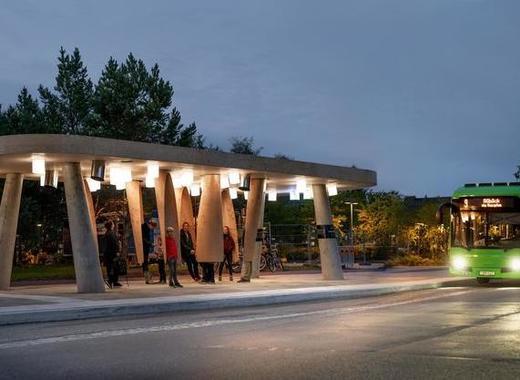
The Station of Being. This is the poetic name given to a bus stop, inaugurated in 2019, being used by people waiting for urban transit lines at the Umeå University. The Municipality of the city located in the Swedish North was happy to announce that this collaborative and innovative project has been nominated for the Beazley Designs of the Year 2020 award – a prestigious annual contest presented by the London Design Museum.
Much research has gone into making the bus stop truly functional
The Station of Being is a product of multi-faceted cooperation between the Umeå Municipality, which has provided investment, RISE – the Swedish Research Institute and Dutch designer Rombout Frieling. It has also been nominated for the 2020 Dezeen Awards.
Why this name though? The idea of its creators was that commuters will be able to let go of their worries, such as constantly checking if the bus is arriving, and just relax and let themselves be.


This bus stop combines a futuristic sci-fi look with homely wooden elements. Source: RISE – Research Institutes of Sweden
The sleek design of the bus stop, which from a distance approximates a wooden table whose underbelly is adorned with several hanging pods reaching almost to the ground level, seems unusual at a first sight but it does attract curiosity and a wish to explore and try it out.
The facility strives to combine intelligent technology with functionality that is in service of the commuters.
For one, its roof is set out to sense out approaching buses and warn the passengers of their approaching using different soft coloured lights and sounds depending on the transit line. That way they can converse with friends or observe the surroundings lost in their thought without fear that they might miss the bus.
The Umeå climate is Nordic and cold, much of this due to the onslaught of winds. At first, one might think that building a bus stop without walls makes no sense in such conditions. This is where the hanging pods come into use. They are made of local wood, sturdy, and best of all, rotate automatically depending on the wind direction.
This allows for people to lean into them and get protection from the wind. On the other hand, they allow for social distancing without the sense of enclosure and herding that would be felt in walled-in bus stops.
It was also reported that the waiting facility has been getting more international attention, such as the time when representatives from the Polish city of Gdansk came to see it first-hand as a possible model for their future bus stops.
Source: TheMayor.EU